

Guitar Scales
Learn Guitar Scales the Visual Way.
Guitar scales feel intimidating when you treat them like math. Five sharps, three flats, intervals, modes — that approach is what makes guitar scales practice feel like homework. The visual approach flips it around. A scale on the guitar is a shape your hand makes. Learn the shape, slide it to a new fret, and you are playing the same scale in a new key. Sisco's Guitar Trainer is built entirely on this principle.
Guitar Scales Are Shapes, Not Theory
The fastest guitar players in the world do not think in note names while they play. They see pentatonic boxes and diatonic mode shapes flying across the fretboard. The shapes are the unit of thought; the note names are something they could derive after the fact if asked. The visual approach to guitar scales gets you to that mental model immediately, without spending weeks memorizing which note belongs to which key.
The Pentatonic Scales Every Player Needs
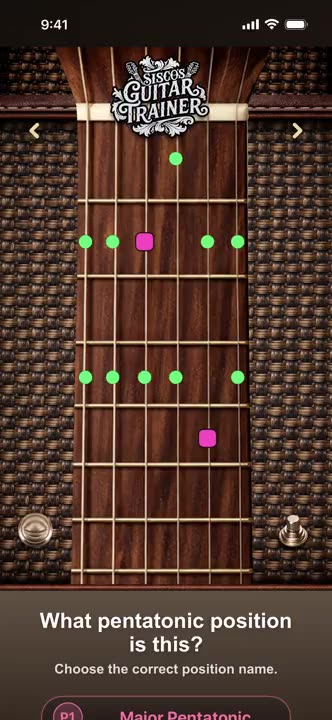
Pentatonic scales are the workhorse of rock, blues, country, and modern lead guitar. There are five movable pentatonic positions, and once you know them you can solo across the entire neck. The minor pentatonic scale alone covers a shocking amount of musical ground — nearly every blues solo you have ever heard is built from five notes arranged in shapes. The app teaches all five positions as patterns first, then layers root awareness on top so you always know which key you are in.
Major and minor pentatonic share the same shapes — you just start them on a different note. That single insight is what turns a wall of pentatonic diagrams into a single repeatable skill.
The Diatonic Modes That Color Your Soloing
When five pentatonic notes is not enough, the diatonic modes give you the full seven-note palette. Ionian for bright major, Dorian for the cool minor sound, Mixolydian for bluesy dominant, Aeolian for the natural minor. Each mode is a different starting point inside the same parent scale, which means once you learn the major scale shape, you already know the rest — you just shift where the pattern feels resolved.
Sisco's Guitar Trainer shows each mode on the live fretboard with no fretboard dots, no note labels, and no theory walls. Just the pattern. Practice the pattern, learn where the root sits, and you have the foundation for serious guitar improvisation.
Move One Shape, Play in Any Key
The most useful idea in all of guitar scales practice is this: a movable shape is a movable key. Learn the Ionian shape with the root on the 3rd fret and you are playing G major. Slide the whole shape up two frets and you are playing A major. The notes inside the shape changed, but your hand did not. That is the power of pattern-based guitar scales, and it is exactly what the Roots Trainer inside the app drills into your eyes and fingers.
From Scale to Song
A scale is only useful if it points at music you can play. The Degrees Trainer inside the app closes the loop by connecting each scale shape to the chord it naturally solos over. Pentatonic Position 1 over the I chord. Mixolydian over the V chord. Aeolian over the vi chord. Once you can identify a pattern and know which chord it lives on, you can solo over real songs — rhythm guitar in the background, lead guitar in your fingers, all of it built from shapes you can see.
What Daily Guitar Scales Practice Looks Like
- Five minutes: drill Position 1 minor pentatonic.
- Five minutes: find the green root inside Position 1 in three different keys.
- Five minutes: switch to Position 2 and play it back-to-back with Position 1.
- Five minutes: AR finger trainer on either pattern — loop until clean.
- Five minutes: improvise over a backing track using only what you just practiced.
Twenty-five minutes of focused guitar scales practice beats two hours of unstructured noodling every time.
Related learn topics
- Master the guitar fretboard — how scale patterns connect across the neck.
- Learn to solo guitar with real pattern practice — turn scales into solos.
- See where guitar chords live on the fretboard — how chords and scales share shapes.
- Learn bass guitar scales and patterns — the same approach, on bass.
Ready to start?
Drill guitar scales as shapes, not theory.